
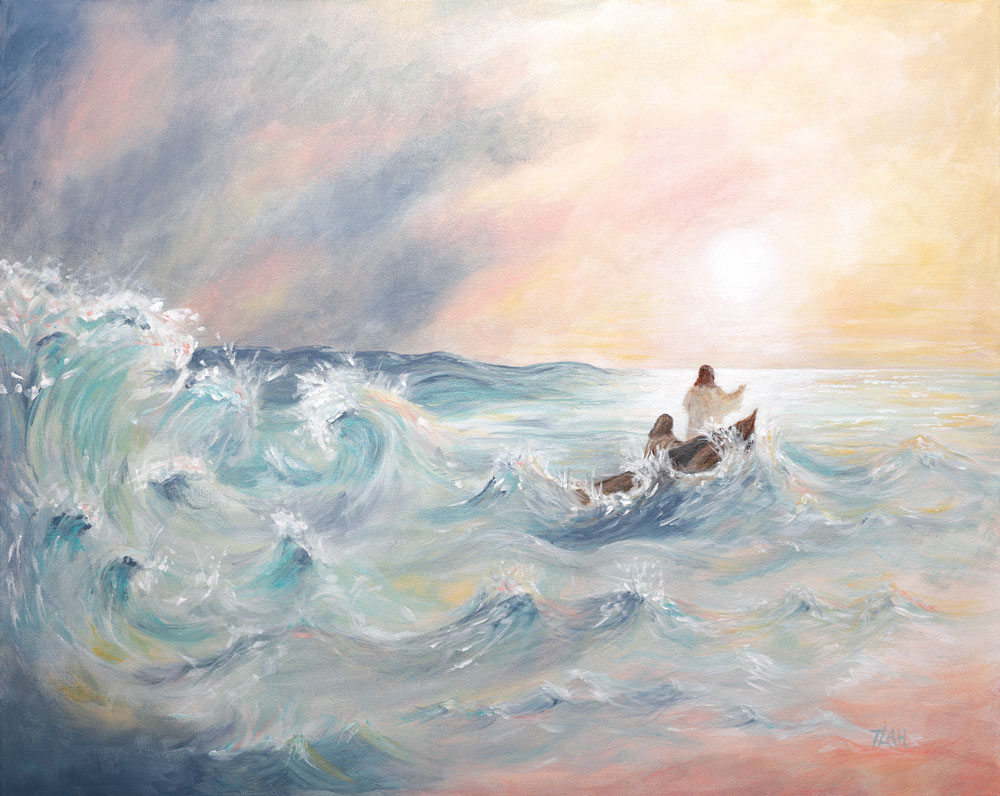
I believe art has a unique capacity to help us "see" God’s work in real-time, and it is my prayer that this contribution helps others see refuge and hope in the One who commands the wind and the waves. This piece, explores the tension between life's storms and the unwavering peace found in the presence of Jesus. My hope is that this imagery serves as a visual anchor, reminding the viewer that even when the waves feel overwhelming, we are never navigating them alone.
From the opening of Scripture’s story in Genesis to the closing vision of Revelation, the sea functions as one of the Bible’s most symbolically rich and theologically loaded images. In the Bible, the sea is more than a mere geographical setting. The sea represents chaos, danger, rebellion, judgment, and death—yet also the stage upon which God reveals his sovereign power, redemptive purpose, and final victory.
The Bible begins with the Spirit of God hovering over the waters of the earth (Genesis 1:2). Ancient Near Easterners typically understood the sea, or “the deep,” to symbolize untamed chaos. Ancient pagan creation myths, for instance, depicted the gods battling sea monsters to tame the earth and establish order. Here in Genesis, however, there is no struggle. The Spirit of God hovers over the waters with no fight or battle scene. Such imagery sets the stage for a core truth that is echoed throughout Scripture’s story: God rules the sea (and all things).
God’s order over the sea is depicted through both historical events and poetic affirmations. The psalmist, for instance, proclaimed, “He gathers the waters of the sea into jars; he puts the deep into storehouses” (Psalm 33:7). Though in ancient thought the waters often implied chaos and evil, God was the one who bound and subdued the seas. God’s rule over the mighty sea then is a key depiction concerning the character of God—he is the Creator, and he rules over all of creation.
The sea, however, also functions in Scripture as an instrument of judgment. In Genesis 6–9, God unleashes the waters of the earth to cause a great flood that wipes out the entire human population, save Noah and his family. In this story, creation is undone, and the chaos of the sea is unleashed as divine judgment upon a world that had turned from God and his ways.
After God repopulates the earth through Noah and his family, he deploys the sea once again as an instrument of judgment against Pharaoh and Egypt—a king and nation that had opposed and oppressed God’s people for hundreds of years. In one of the more dramatic narratives in all the Bible, God swallows Pharaoh’s army amid the sea—a shocking depiction of the might of God and his ability to control the sea for his own purposes.
God’s people would regularly look back on this Red Sea deliverance as a historical marker of God’s working on their behalf. Isaiah, for instance, recounted, “Was it not you who dried up the sea, the waters of the great deep, who made a road in the depths of the sea so that the redeemed might cross over?” (Isaiah 51:10). While the psalmist rejoiced, “He rebuked the Red Sea, and it dried up; he led them through the depths as through a desert. He saved them from the hand of the foe; from the hand of the enemy he redeemed them” (Psalm 106:9–10).
For God’s people then, the sea was a vivid image of God’s power to both judge and save. God is the one who rules the sea and moves it in accord with his divine purposes.
This dynamic would become especially clear in God’s showdown with his own prophet, Jonah. Jonah was a prophet of Israel commissioned to preach against the Assyrian capital of Nineveh. However, instead of traveling to Nineveh (which would have been by road), Jonah boarded a ship and sailed in the opposite direction. God then hurled the sea at Jonah’s ship until he was eventually tossed overboard, and the sea became calm. The sea, then, in this narrative, becomes the arena or stage of divine pursuit. God wields the sea (and a large fish) to capture Jonah’s heart and redirect his course.
As the story of Scripture transitions to the New Testament, the Sea of Galilee becomes a primary stage upon which Jesus shows his divine power. Much like in the creation story, Jesus calmed the sea with a mere word. At his command, the winds die down, and the raging sea is stilled. The mighty God who spoke the sea into existence is revealed through Jesus, who demonstrated power and authority over the waters.
Further, Jesus’s walking on the water showcased his mastery over chaos (Mark 6:45–52). In the Old Testament, it was only God who treaded upon the waves (Job 9:8). Here, Jesus demonstrates once again his divine identity and power over the chaotic waters.
The story of Scripture comes to a dramatic close with John’s vision of a new heaven and a new earth (Revelation 21:1–8). As part of this climatic vision, the sea is no more. Throughout Revelation, the sea is pictured as the center of chaos and the dramatic battlefield out of which the enemies of God arise (see, for instance, Revelation 13:1). Here, however, there is no closing battle. It’s just simply a declaration: the sea is gone, and God has established a new creation where peace reigns, and chaos is done away with.
The story of Scripture thus ends where it began, but now redeemed. The chaotic sea has been subdued, and God’s people reign with God in a restored creation purged of God’s enemies and the raging waters.
The dramatic tale of God’s rule over the waters should thus inspire our confidence in the one who reigns over all things. Though the waters may be raging, we have a God who rules over the sea.
Ethan oversees the men’s and couple's ministry at Ada Bible's Bella Vista campus and is a frequent writer for Beyond the Weekend devotional. If you are interested in more of Ethan’s writing, visit his website at walkbytheword.com.